 Add to Chrome
 Add to Firefox
 Add to Edge
Seismology modeling agent: A smart assistant for geophysical researchers
Dec 16, 2025
To address the steep learning curve and reliance on complex manual file editing and command-line operations in the traditional workflow of the mainstream open-source seismic wave simulation software SPECFEM, this paper proposes an intelligent, interactive workflow powered by Large Language Models (LLMs). We introduce the first Model Context Protocol (MCP) server suite for SPECFEM (supporting 2D, 3D Cartesian, and 3D Globe versions), which decomposes the entire simulation process into discrete, agent-executable tools spanning from parameter generation and mesh partitioning to solver execution and visualization. This approach enables a paradigm shift from file-driven to intent-driven conversational interactions. The framework supports both fully automated execution and human-in-the-loop collaboration, allowing researchers to guide simulation strategies in real time and retain scientific decision-making authority while significantly reducing tedious low-level operations. Validated through multiple case studies, the workflow operates seamlessly in both autonomous and interactive modes, yielding high-fidelity results consistent with standard baselines. As the first application of MCP technology to computational seismology, this study significantly lowers the entry barrier, enhances reproducibility, and offers a promising avenue for advancing computational geophysics toward AI-assisted and automated scientific research. The complete source code is available at https://github.com/RenYukun1563/specfem-mcp.

Dynamic Budget Throttling in Repeated Second-Price Auctions
Jul 15, 2022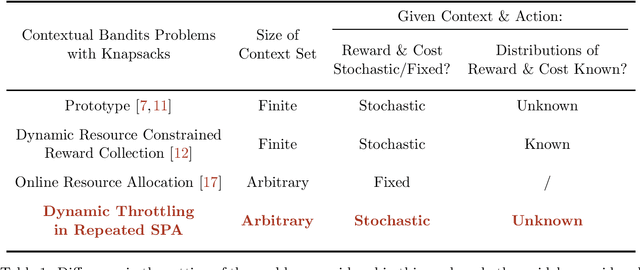
Throttling is one of the most popular budget control methods in today's online advertising markets. When a budget-constrained advertiser employs throttling, she can choose whether or not to participate in an auction after the advertising platform recommends a bid. This paper focuses on the dynamic budget throttling process in repeated second-price auctions from a theoretical view. An essential feature of the underlying problem is that the advertiser does not know the distribution of the highest competing bid upon entering the market. To model the difficulty of eliminating such uncertainty, we consider two different information structures. The advertiser could obtain the highest competing bid in each round with full-information feedback. Meanwhile, with partial information feedback, the advertiser could only have access to the highest competing bid in the auctions she participates in. We propose the OGD-CB algorithm, which involves simultaneous distribution learning and revenue optimization. In both settings, we demonstrate that this algorithm guarantees an $O(\sqrt{T\log T})$ regret with probability $1 - O(1/T)$ relative to the fluid adaptive throttling benchmark. By proving a lower bound of $\Omega(\sqrt{T})$ on the minimal regret for even the hindsight optimum, we establish the near optimality of our algorithm. Finally, we compare the fluid optimum of throttling to that of pacing, another widely adopted budget control method. The numerical relationship of these benchmarks sheds new light on the understanding of different online algorithms for revenue maximization under budget constraints.